
Tell the world I'm coming home
The body in crisis, and the last decision

“I’m in a lot of pain! I’m in a lot of pain!”
One of life’s toughest choices is deciding between saving a body and letting a loved one go in peace. We often worry about what might happen, but when it does, we’re usually caught off guard.
When a body is in crisis, you call an ambulance. Next is data collection: checking temperature, oxygen saturation, heart rate, and blood glucose. A body can be broken into data sets like oxygen, carbon dioxide, heart rate, blood pressure, blood glucose, and electrolyte levels. Oxygen is delivered through a cylinder when levels fall below a safe range. In extreme conditions, breathing is taken over by a ventilator.
Our bodies function when these datasets stay in balance. Each value moves within a range. In Chinese thought, this balance is called yin and yang. In medicine, values are shown as negative or positive. They are measured accurately, not just felt.
Data informs what happens next. But precise predictions are rarely possible, as values fluctuate constantly. Medical professionals make decisions and hold the responsibility and liability for them. Biology was my favorite subject in school. I find it fascinating to understand how a heart works to keep blood moving through the body and how our lungs sustain life with every breath.
My grandmother, yet, follows a completely different method. She believes certain foods warm the body, while others cool it. She would look at the color of my lips and make a swift comment on her thoughts about what was happening inside my body. Maybe that is why going to the hospital is such a frightening experience for her. Suddenly, she loses control over how to care for her body and has to accept that the wisdom she has relied on for years no longer holds authority there.
She probably never knew what a human heart actually looks like, yet she has always found ways to heal herself with the remedies she makes.
I find myself recalling old notes, trying to match them with the mental notes she might have, even though her mind may no longer be a clear place after the shock of intense ventilation and antibiotics.
Most of our bodies share similar limits, whether we like it or not. We pass through the same four passages in life: birth (生 shēng), aging (老 lǎo), illness (病 bìng), and death (死 sǐ).
We, as Homo sapiens, have long tried to interpret what death means. We keep searching for ways to delay aging, from ancient promises of immortality to modern anti-aging innovations that claim to slow the decline of our organs, from Qin Shi Huang to longevity guru Bryan Johnson. Alongside this, we have tried to understand the beginning and the end of life through inherited stories.
“We’re all just trying to survive.”
I said this and looked at my friend. We sat beside my grandmother’s hospital bed in silence, listening to her breathing through the ventilator and our own. It was also my attempt to soothe an anxious friend who could not help but imagine herself lying in bed.
We are all just looking for safety in an unpredictable, uncertain world, trying to make sense of a world that we are in and grasp for whatever security remains.
My spiritual journey has been a lot like Pi’s. He was raised in a Hindu family, then introduced to Christianity and Islam, and decided to follow all three. I was raised in a lineage family that practiced Taoism, then introduced to Catholicism at 6, Christianity at 10, and Buddhism at 13. It was not that I did not want to love God, but perhaps I would find belief easier if God were a woman.
We all share similar fears: fear of shame and fear of humiliation. Today, two fears in particular, fear of missing out and fear of looking stupid, often get in the way of decision-making, as Sequoia partners Pat Grady and Alfred Lin have pointed out. Many wrong bets are driven by psychological bias rather than spreadsheet errors, what they describe as a failure to maintain a “separation of church and state,” meaning not letting the thrill of the chase (emotion) bleed into clinical decision-making (truth).
“The only thing we have to fear, is fear itself.” — President Franklin Roosevelt
Chinese religious traditions often emphasize samsara, the afterlife, and karma, focusing on cycles of return and consequence rather than a singular idea of heaven. Whether rebirth or salvation, we, as Homo sapiens, seem to find it hard to accept that we are nothing more than bodies made of data.
Ironically, we romanticize a kind of true love we would be willing to die for, even as we dismiss emotion-guided decisions in everyday life. From Romeo and Juliet to The Flower Princess (《帝女花》), my grandmother’s favorite show, love is remembered not for its practicality, but for its refusal to compromise.
In a world where marriages were arranged and individual choice was limited, our longing for love that transcends duty, survival, and reason became something sacred. These stories endure because they give dignity to feeling, suggesting that a life guided only by calculation may survive, but it does not fully live.
No matter how carefully we hide our brightest, or darkest, longings, near the end, on a hospital bed, every trace of fear has nowhere to hide.
A natural death turns out to be far messier than I could imagine. We move through moments of clarity and confusion, cycles of delirium, adrenaline-driven rallies, and episodes of terminal lucidity. It is hard to accept that the mind can no longer anchor itself in a logical, linear world. We spend our lives trying to optimize our patterns, yet sometimes, no matter how hard we try, the body refuses to be optimized.
“She couldn’t read, and I studied until I got a master’s.”
I sighed outside the ward. Accompanying a dying family member was overwhelming. There was nothing to do but watch the body fluctuate, waiting until the numbers no longer argued for recovery. Having briefly encountered so many different religions, I have yet to fully formulate, or put into words, what death means to me.
I struggled to believe that a body that once sang songs across Hong Kong now struggled even to take a proper breath. I had moved through cities, working hard to be as articulate as possible, and now I found myself speaking my Weitou dialect to comfort a mind. No matter how much we live, one day we return almost to zero. And when love can no longer be expressed through words, it must find another form.
At the end of your life, the only thing you can take with you is karma. (萬般帶不走,唯有業隨身)
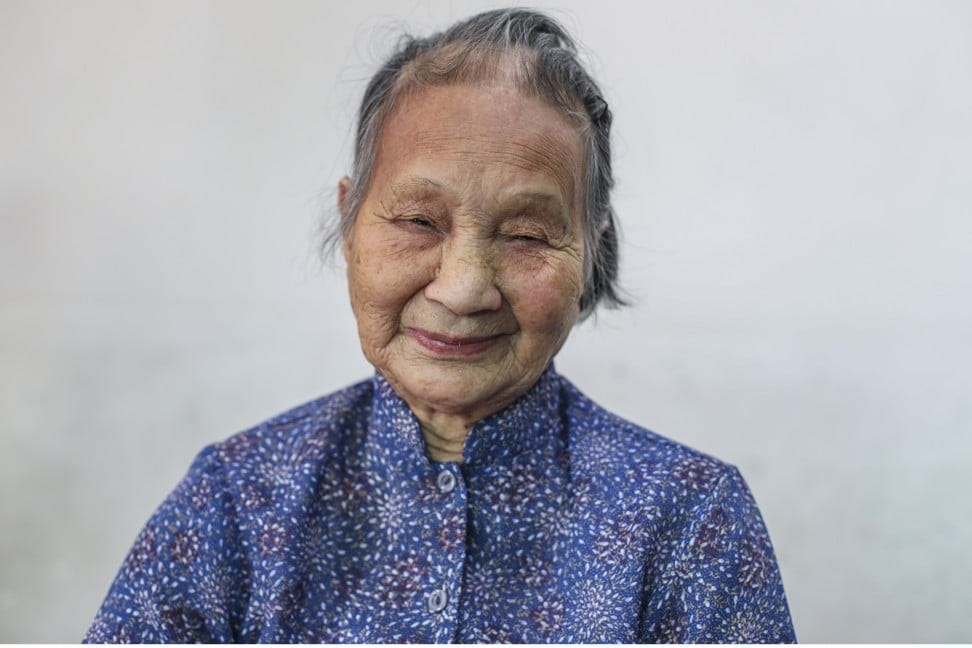
In Chinese culture, there are two kinds of important gatherings: those for marriage and those for death (紅白二事). A woman takes her husband’s surname on the day she marries. My grandmother became Aunt Xi, defined by her marriage to my grandfather Tang Xi, when she wed at 22. Near death, as she moved between hospital rooms and surgery beds, after 70 years, she was finally called by her own name again: Liu Kam-lan.
Nvidia’s Jensen Huang once said that to be a CEO is a lifetime of sacrifice. If that is true, then women have long embodied servant leadership at home, as homemakers. The difference is this: you only get to retire on the day you die. That is the day you are finally allowed to rest.
Written in the week before the winter solstice.